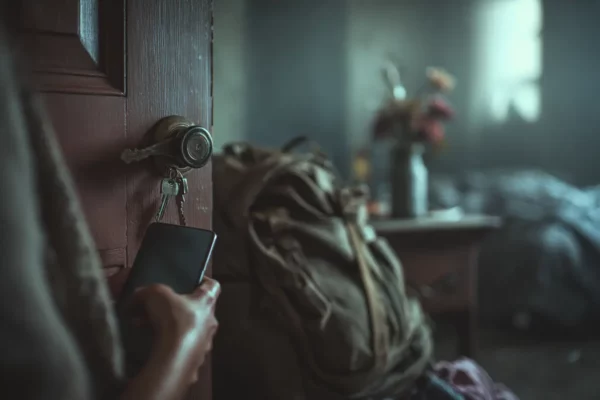


Codependency rarely announces itself as “I have stopped living my own life.” It usually starts smaller. You check whether they came home. You listen for breathing through the wall. You count money. You cancel your plans. You explain the adult’s behavior to the children again. You promise yourself you will stop monitoring, then open the phone anyway.
From the outside, it can look like care. Inside, it feels like being on call all the time.
At OpenHalt, we use codependency as a working description of patterns, not as a diagnosis and not as blame. It is a way to talk about what happens when someone else’s addiction becomes the center of your nervous system, your choices, and your day.
Codependency is not proof that you failed
Loved ones often arrive at this topic already ashamed. They think they said the wrong thing, helped too much, helped too little, pushed too hard, or did not push enough.
But codependent patterns often grow out of fear. When addiction brings relapses, debt, binges, disappearances, threats, or unsafe behavior, the mind looks for control in a situation where control is limited.
The trouble is that this survival strategy can start harming both people: the person with addiction meets fewer consequences, while the loved one has less and less room for their own life.
What codependency can look like at home
You monitor more than you live
Phone, location, messages, pockets, smell, pupils, tone of voice. Checking can bring a few minutes of relief. Then anxiety asks for the next check.
The trap is cruel: the more you monitor, the less safe you feel inside yourself.
You cover the consequences
Paying a debt, lying to an employer, cleaning up evidence, smoothing things over with relatives, sending a message for them. In the moment, it can feel like preventing disaster.
Repeated over time, it can keep the addiction system running. Support turns into consequence management.
Boundaries feel like betrayal
“If I do not give money, they will spiral.” “If I leave the conversation, they will think I abandoned them.” “If I call for help, they will hate me.”
Codependency often survives on this private bargain: I will carry more pain so something worse does not happen. The price keeps rising.
What research says about addiction-affected families
A qualitative systematic review by Mardani and colleagues describes how addiction-affected families face emotional strain, disrupted roles, financial pressure, stigma, and social isolation.
Research on Community Reinforcement and Family Training, or CRAFT, suggests that work with loved ones can support treatment entry for people who are not yet ready for help. This does not make the loved one responsible for another adult’s recovery. It means families also need skills, language, and support.
In gambling research, the phrase concerned significant others is used for people affected by someone else’s addictive behavior. That phrase matters: the harm does not stop at the person who uses, gambles, or relapses.
Support versus rescuing
Support helps the person take the next responsible step. Rescuing takes the step for them.
Support: “I can help you find a clinician and go with you to the first appointment.”
Rescuing: “I will lie for you again, pay the debt, hide the damage, and pretend nothing happened.”
Support preserves dignity and responsibility. Rescuing absorbs responsibility and often calls it love.
Boundaries do not have to sound cruel
A boundary is not punishment. It is a clear statement of what you will do so you do not disappear inside the crisis.
You might say:
- “I will not have serious conversations when you are intoxicated.”
- “I will not give cash if it may go toward substances or gambling.”
- “I will not hide violence or threats.”
- “I am willing to support treatment. I am not willing to live in constant lying.”
- “If there is overdose, suicide, psychosis, or violence risk, I will call for help.”
A boundary can be calm. It does not need to be cold.
When urgent help is needed
If there is overdose, loss of consciousness, seizures, severe withdrawal, psychosis, suicidal threats, self-harm, violence, or dangerous behavior, do not try to solve it with a family conversation. Contact local emergency services, the nearest medical or crisis service, and, when there is immediate danger, rescue services or police according to local law.
Codependency may whisper, “Do not expose the family.” Safety answers, “Life matters more than shame.”
What to do in the next 24 hours
- Write down facts: what is happening, how often, and what risks are present.
- Separate real help from covering consequences.
- Choose one boundary you can actually keep.
- Find support for yourself: therapist, family support group, family consultation, anonymous chat.
- Do not start a major conversation during intoxication or aggression.
- Make an urgent safety plan if overdose, violence, or suicide risk is possible.
A psychologist’s view
There is often more love inside codependency than outsiders understand. But love living in fear begins to look like control. The person no longer asks, “What do I want?” They ask, “How do I prevent disaster today?”
Work on codependency does not begin with “stop helping.” It begins with a more honest question: what kind of help actually helps, and what kind simply moves the consequences onto you?
FAQ
Is codependency a diagnosis?
In this article, codependency is used as a working description of patterns: control, rescuing, lost boundaries, and living around someone else’s addiction. Diagnosis belongs with qualified professionals, not an article.
How do I know whether I am supporting or rescuing?
After support, the person is closer to responsibility and help, and you still have safety, money, sleep, and a life. In rescuing, you hide consequences, pay, lie, tolerate threats, and slowly disappear.
Can I recover from codependent patterns if the other person keeps using?
Yes. Boundary work and support for yourself can begin even if the other person is not ready for treatment. It does not guarantee their recovery, but it can help you step out of constant control and chaos.
What if the addicted person is dangerous?
If there is violence, threats, overdose, psychosis, suicide risk, severe withdrawal, or dangerous behavior, seek urgent local help. Do not stay alone with a threat.
Where can family members get help?
You can start with a therapist, family therapist, support group for loved ones, addiction clinician, crisis service, or anonymous chat. Help should not be only for the person with addiction. It should include you too.
OpenHalt
OpenHalt is for people who are tired of living between love, fear, and control. If you recognize yourself in rescuing, this is not a reason to blame yourself. It is a reason to get support too.
You can start with one message: what you are carrying for someone else, which boundary feels impossible, and where you need steadier ground.
If there is overdose risk, violence, psychosis, self-harm, or suicidal thoughts, seek urgent help in your country first.
Join the chat “Where am I when I keep rescuing?”
Keep reading
- Codependency: love that became ill
- Codependency vs partnership: family as a team in recovery
- Codependency personal story: how Inna stopped rescuing everyone at the cost of herself
Sources
- Mardani M. et al., BMC Psychiatry, 2023. Challenges in addiction-affected families: a systematic review of qualitative studies. PMID: 37328763, DOI: 10.1186/s12888-023-04927-1. Source for the lived strain in addiction-affected families: https://pubmed.ncbi.nlm.nih.gov/37328763/
- Archer M. et al., Addiction, 2020. Community reinforcement and family training and rates of treatment entry: a systematic review. PMID: 31770469, DOI: 10.1111/add.14901. Source for CRAFT and loved-one involvement in treatment entry: https://pubmed.ncbi.nlm.nih.gov/31770469/
- Roozen H.G. et al., Addiction, 2010. Community reinforcement and family training: an effective option to engage treatment-resistant substance-abusing individuals in treatment. PMID: 20626372, DOI: 10.1111/j.1360-0443.2010.03016.x. Source for CRAFT and concerned significant others: https://pubmed.ncbi.nlm.nih.gov/20626372/
- Edgren R. et al., Journal of Behavioral Addictions, 2022. Treatment for the concerned significant others of gamblers. PMID: 35044325, DOI: 10.1556/2006.2021.00088. Source for support for people affected by gambling-related harm: https://pubmed.ncbi.nlm.nih.gov/35044325/
- Schneider L.A. et al., Journal of Behavioral Addictions, 2017. Family factors in adolescent problematic Internet gaming. PMID: 28762279, DOI: 10.1556/2006.6.2017.035. Source for family environment and problematic gaming: https://pubmed.ncbi.nlm.nih.gov/28762279/
- Wang H. et al., Journal of Behavioral Addictions, 2024. Family-based therapy for internet addiction among adolescents and young adults. PMID: 38635339, DOI: 10.1556/2006.2024.00015. Source for family-based interventions in problematic internet use: https://pubmed.ncbi.nlm.nih.gov/38635339/
- NICE CG51, Drug misuse in over 16s: psychosocial interventions. Source for psychosocial support and referral to specialist care: https://www.nice.org.uk/guidance/cg51
- WHO/UNODC, International Standards for the Treatment of Drug Use Disorders, 2020. Source for comprehensive and ethical treatment systems: https://www.who.int/publications/i/item/international-standards-for-the-treatment-of-drug-use-disorders