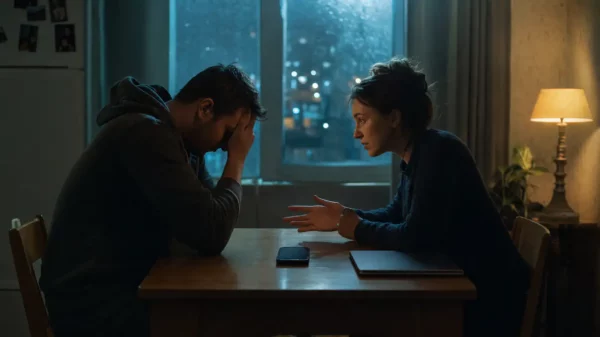


The hardest question for loved ones is rarely “what is gambling disorder?” It is usually more painful: “If I do not help with this debt, everything may collapse. If I do help, will they gamble again?”
Gambling addiction can pull the whole family into its orbit. Someone pays off loans. Someone hides the problem from parents. Someone checks phones. Someone threatens to leave and then stays to put out the next fire.
You can help. But help is not the same as endless rescue. It starts with three things: safety, honest conversation, and boundaries.
Check safety first
If the person talks about death, self-harm, disappearing, violence, being unable to stay safe, substance use, dangerous behavior, driving in panic, or having “no way out” after a loss, do not leave them alone. Seek urgent local help: emergency services, the nearest crisis service, an emergency department, or local psychiatric support.
The debt conversation can wait. Life and safety cannot.
Do not start with an interrogation
Loved ones often want all the answers right away: how much, where, who is owed, why again, how many promises were broken. That reaction makes sense. But if the first conversation feels like an investigation, the person may shut down, lie more carefully, or gamble again to “fix it first.”
Start shorter:
- “I can see gambling is out of control.”
- “I am willing to help with a plan, but I will not give money that keeps the cycle going.”
- “I need the truth, and we are going to talk without screaming.”
- “If you are in danger, we get help first.”
This does not remove responsibility. It removes the stage where shame takes over the whole room.
Support is not the same as paying debt
Paying a gambling debt can feel like the fastest way to rescue the situation. Sometimes there may be an immediate legal or safety reason to act. But if nothing changes afterward – access to betting, cards, loans, secrecy, isolation, treatment – paying the debt can become part of the cycle.
Support can look different:
- help write down the full debt picture;
- call the bank or a financial adviser together;
- avoid giving cash or access to new credit;
- discuss self-exclusion and blocking gambling services;
- help find a therapist, support group, or gambling harm service;
- agree which expenses temporarily need another adult involved;
- stop secretly covering consequences for everyone else.
A clear sentence can be: “I will not pay to keep gambling going. I will help with safety, treatment, and a debt plan.”
What to do with cards, loans, and apps
With gambling addiction, access matters. When the urge rises, one click can become a deposit.
Ask the person to make the environment less dangerous, not just to “try harder”:
- delete betting and casino apps;
- turn off gambling emails and push notifications;
- set card limits;
- block gambling transactions if the bank allows it;
- use self-exclusion tools where available;
- avoid taking payday loans alone;
- limit access to large sums for a while;
- agree who holds certain cards or documents if the person chooses that as part of the plan.
Humiliating control often damages trust. Agreed safety measures work better.
How to speak when they deny the problem
Denial is not always arrogant lying. Sometimes the person still believes they can control it.
Do not argue about the label “addiction.” Talk about facts:
- “This amount was lost this month.”
- “You promised to stop and then bet again.”
- “We have already hidden this from family.”
- “Bills are unpaid because of gambling.”
- “After losing, you said you did not want to live.”
Facts hurt less than labels and are harder to turn into a debate about character.
What treatment can involve
NICE and gambling harm research often point toward structured help: identifying harm, assessing risk, psychological and psychosocial support, family involvement, reducing access, and relapse prevention.
Cognitive behavioral therapy
CBT can help challenge thoughts that keep gambling alive: “I almost won,” “I have a system,” “I can win it back and then stop,” “if I tell the truth now, everything will fall apart.”
For loved ones, this means you do not have to become the therapist at home. A better role is helping the person reach professional support and keep practical agreements between sessions.
Brief interventions and motivational conversations
Sometimes the first step is not long-term therapy but a short, honest conversation with a professional where the person sees the link between gambling and consequences. Research on brief interventions suggests they can be useful for some gambling problems, though they are not a replacement for fuller care when risk is high.
Family support
Family can support recovery when it does not become the police or the bank. Useful support includes clear rules, calm consequences, money agreements, attending consultations, and help for the loved ones themselves.
Medication
The American Psychiatric Association notes that there are no FDA-approved medications specifically for gambling disorder. Pharmacological reviews study possible options, but evidence is mixed. If depression, anxiety, alcohol use, substance use, ADHD, bipolar symptoms, or insomnia are present, a clinician should assess the whole picture.
Take care of yourself too
Loved ones have limits. You can love someone and refuse to hand over your last money. You can care and refuse to lie for them. You can be scared and still set boundaries.
Ask yourself:
- which debts have I already covered;
- what am I hiding from others;
- where am I helping, and where am I feeding the game;
- is there violence or threat risk;
- who can I talk to for my own support;
- which boundaries can I hold for a month, not only for one day.
A depleted loved one cannot carry the whole recovery plan.
A plan for today
- Check for risk of suicide, self-harm, violence, substance use, or dangerous behavior.
- Say one calm sentence: “I will help with recovery, but I will not pay for gambling to continue.”
- Ask for a debt list without yelling or public humiliation.
- Agree on blocks: apps, cards, gambling marketing, self-exclusion.
- Look for a therapist, support group, or gambling harm service.
- Do not take new loans to cover the old gambling loss.
- Bring in another trusted adult if the situation is heavy.
- If there are suicidal thoughts, threats, substances, or violence, seek urgent help first.
A psychologist’s view
Loved ones often get stuck between two roles: rescuer and prosecutor. In one role they pay, hide, and keep quiet. In the other they shout, inspect, and shame. Both are exhausting.
A more adult position is not soft or harsh. It is clear: “I see the problem. I am with you in getting out. I am not with you in keeping it going.”
That may feel uncomfortable for everyone. But clarity can become the first real shore.
FAQ
Should I pay the gambling debts?
Not automatically. Some debts may require urgent legal or safety planning, but paying without limits, treatment, and transparency can keep the gambling cycle alive. Separate debt planning from “one last rescue.”
What should I say when they ask for money and promise to stop?
You can say: “I hear that you are scared. I will not give money that keeps the cycle going. I can help you contact support, block gambling access, and make a debt plan.”
Is it okay to control their phone and cards?
Only as part of an agreed safety plan, not through humiliation or secret surveillance. Voluntary limits, bank blocks, self-exclusion, and professional support usually work better.
What if they refuse help?
Speak in facts, hold boundaries, do not pay for gambling, protect your own safety, and get support for yourself. If there are threats to life, violence, or dangerous behavior, involve urgent help.
When should I call emergency help?
Call emergency or crisis support if the person talks about suicide or self-harm, threatens themselves or others, disappears after a loss, is intoxicated, behaves dangerously, or cannot commit to staying safe.
Conclusion
Helping someone with gambling addiction does not mean becoming their bank, detective, or only lifeline.
Help means staying in contact, refusing to feed the gambling cycle with money, reducing access to betting, telling the truth, involving professionals, and remembering your own safety. Sometimes the most honest sentence is: “I am with you in recovery, not in the game.”
OpenHalt
OpenHalt is for people living close to addiction who are tired of carrying everything alone. If someone you love gambles, borrows, promises to stop, and then returns to betting, you need support too.
You can enter the chat without a perfect plan and start with the truth: “I do not know where helping ends and enabling begins anymore”.
If there is risk of suicide, self-harm, violence, substance use, or loss of control, seek urgent local help first.
Join the chat “Someone I love gambles”
Keep reading
- Gambling addiction: signs, stages, and when to get help
- Gambling and suicide risk: when a loss becomes dangerous
- Addiction recovery safety plan: how to lower relapse risk
Sources
- World Health Organization. Gambling, fact sheet, 2024: https://www.who.int/news-room/fact-sheets/detail/gambling. Supports the overview of gambling harm for mental health, family life, finances, and safety.
- NICE. Gambling-related harms: identification, assessment and management, NG248, 2025: https://www.nice.org.uk/guidance/ng248. Supports identification, assessment, family support, psychological help, and relapse prevention.
- American Psychiatric Association. What is Gambling Disorder?: https://www.psychiatry.org/patients-families/gambling-disorder/what-is-gambling-disorder. Supports patient-facing explanation of gambling disorder, family involvement, and medication caution.
- Pfund RA et al. Cognitive-behavioral treatment for gambling harm: Umbrella review and meta-analysis. Clinical Psychology Review, 2023. PMID: 37717456. DOI: 10.1016/j.cpr.2023.102336. https://pubmed.ncbi.nlm.nih.gov/37717456/. Supports the section on CBT for gambling harm.
- Quilty LC et al. Brief interventions for problem gambling: A meta-analysis. PLOS One, 2019. PMID: 30995229. DOI: 10.1371/journal.pone.0214502. https://pubmed.ncbi.nlm.nih.gov/30995229/. Supports careful wording on brief interventions.
- Petry NM et al. A systematic review of treatments for problem gambling. Psychology of Addictive Behaviors, 2017. PMID: 28639817. DOI: 10.1037/adb0000290. https://pubmed.ncbi.nlm.nih.gov/28639817/. Supports the overview of treatment options.
- Mallorquí-Bagué N et al. Craving in gambling disorder: A systematic review. Journal of Behavioral Addictions, 2023. PMID: 36787136. DOI: 10.1556/2006.2022.00080. https://pubmed.ncbi.nlm.nih.gov/36787136/. Supports the discussion of craving and reducing access to gambling.
- Ioannidis K et al. Pharmacological management of gambling disorder: A systematic review and network meta-analysis. Comprehensive Psychiatry, 2025. PMID: 39675219. DOI: 10.1016/j.comppsych.2024.152566. https://pubmed.ncbi.nlm.nih.gov/39675219/. Supports cautious wording on mixed medication evidence.