

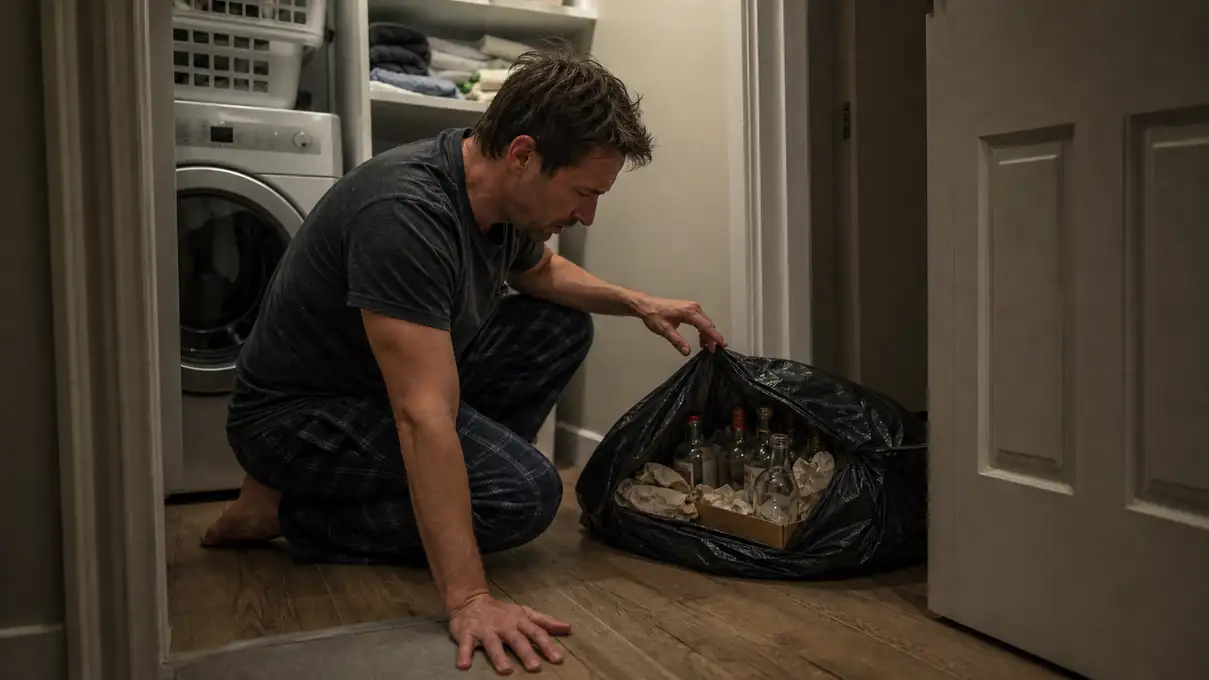
Admission can feel too large
Sometimes a person already sees the facts: control is moving, consequences repeat, loved ones are worried, promises do not hold, something inside feels frightening. And still, saying “I have a problem” can feel almost impossible.
This is not always stubbornness. Admission can feel like a door after which everything must change at once: stop, explain, get treatment, tell people, lose face, change friends, argue with family, look at shame.
The mind tries to protect itself from a step that feels too big. A person may avoid admitting the problem not because they do not care, but because the truth feels dangerous.
What the person is really afraid of
1. Losing the image of self
“I am strong”, “I am reasonable”, “I am not like that”, “I manage.” Admitting a problem can feel like destroying a familiar identity. But an addiction problem does not erase intelligence, value, experience or dignity.
2. Losing a way to cope
Even a harmful cycle often has a function: reducing anxiety, numbing loneliness, creating a pause, helping not to feel. So giving up self-deception can be frightening: how will I live without this way of coping?
3. Hearing other people’s shame
A person may fear not only their own truth, but also other people’s reactions: blame, control, pity, threats, conversations behind their back. So admitting it to oneself can feel like the start of a public trial.
4. Admitting losses
If you admit the problem, you may have to see what has already been lost: health, money, trust, time, closeness, safety. That hurts.
5. Not knowing what to do next
Sometimes denial is held up by a simple fear: if I admit it, I must know the plan. But admission does not have to be a whole life plan. It can be one sentence: “I need help with the next step.”
Admission is not a sentence
NIDA and NIAAA describe addiction and alcohol use disorder as conditions for which people can receive help and recover. Admitting a problem does not mean life is over. It means you no longer have to solve everything only inside your own head.
Truth can hurt, but it gives a point to stand on. While a person argues with facts, energy goes into defense. When they admit even part of the truth, that energy can move toward safety.
You can admit it in small steps
You do not have to say “I am addicted forever” immediately. You can begin more gently and accurately:
- “I lose control more often than I want to”;
- “the consequences are already repeating”;
- “I am afraid of taking a pause”;
- “I hide more than before”;
- “I need support to understand this.”
Sentences like these do not break a person. They bring reality back to a size that can be worked with.
If admission brings despair
Sometimes truth brings heavy shame: “I ruined everything”, “no one will forgive me”, “there is no point”, “it would be better to disappear.” In that moment, you should not stay alone with those thoughts.
If there are suicidal thoughts, self-harm risk, threat to life, confusion, severe withdrawal, seizures or hallucinations, urgent help is needed. OpenHalt does not replace emergency services, a doctor or a crisis line.
What to do today
- write one honest sentence without a label;
- choose one person or anonymous chat where you can say it safely;
- do not promise your whole life, choose the next 24 hours;
- remove one access point that makes relapse easier;
- if there is life risk or severe withdrawal, seek urgent help.
FAQ
Why is it so frightening to admit addiction to yourself?
Because admission can feel like a threat to identity, relationships, the familiar way of coping, hope of control and the idea of the future.
Does admitting it mean I am weak?
No. Admitting a problem does not cancel dignity or strength. It can be the first action that returns safety and choice.
Can I admit the problem without a public confession?
Yes. You can start with yourself, a professional, one safe person, a support group or an anonymous chat. You do not need to tell everyone immediately.
What if I feel much worse after admitting it?
Do not stay alone. If there are suicidal thoughts, self-harm risk, severe withdrawal, confusion, seizures or hallucinations, urgent help is needed.
OpenHalt
OpenHalt can be a place for the first honest sentence. You can write anonymously: “I am afraid to admit it to myself, but I see a problem.” In chat or a psychologist-led room, you do not have to prove everything at once. You can calmly look at facts, fear and the next safe step.
If there are suicidal thoughts, self-harm risk, severe withdrawal, seizures, confusion, hallucinations or threat to life, urgent help comes first.
In anonymous chats, you can write about fear that is hard to explain to loved ones and get a calmer response.
Open anonymous fear support chats
In OpenHalt rooms, psychologists and psychotherapists lead focused conversations, help make sense of patterns, and offer a safer next step.
Find specialist-led rooms on this topic
If you want one-to-one support, you can search for a specialist by topic, read their profile, and start with a clear first contact.
Read next
- Alcohol addiction defense mechanisms
- Addiction recovery: relapse, motivation and family support
- How to deal with anxiety
Sources
- NIDA: Treatment and Recovery – supports treatment, help and recovery framing.
- NIAAA: Alcohol Use Disorder, From Risk to Diagnosis to Recovery – supports AUD signs and recovery possibility.
- NIMH: Warning Signs of Suicide – supports urgent help framing for suicidal thoughts.
- WHO/UNODC: International Standards for the Treatment of Drug Use Disorders – supports an evidence-based care approach.