

Introduction
Some childhoods are technically over, but the body keeps living as if the door is about to open and everything will change again.
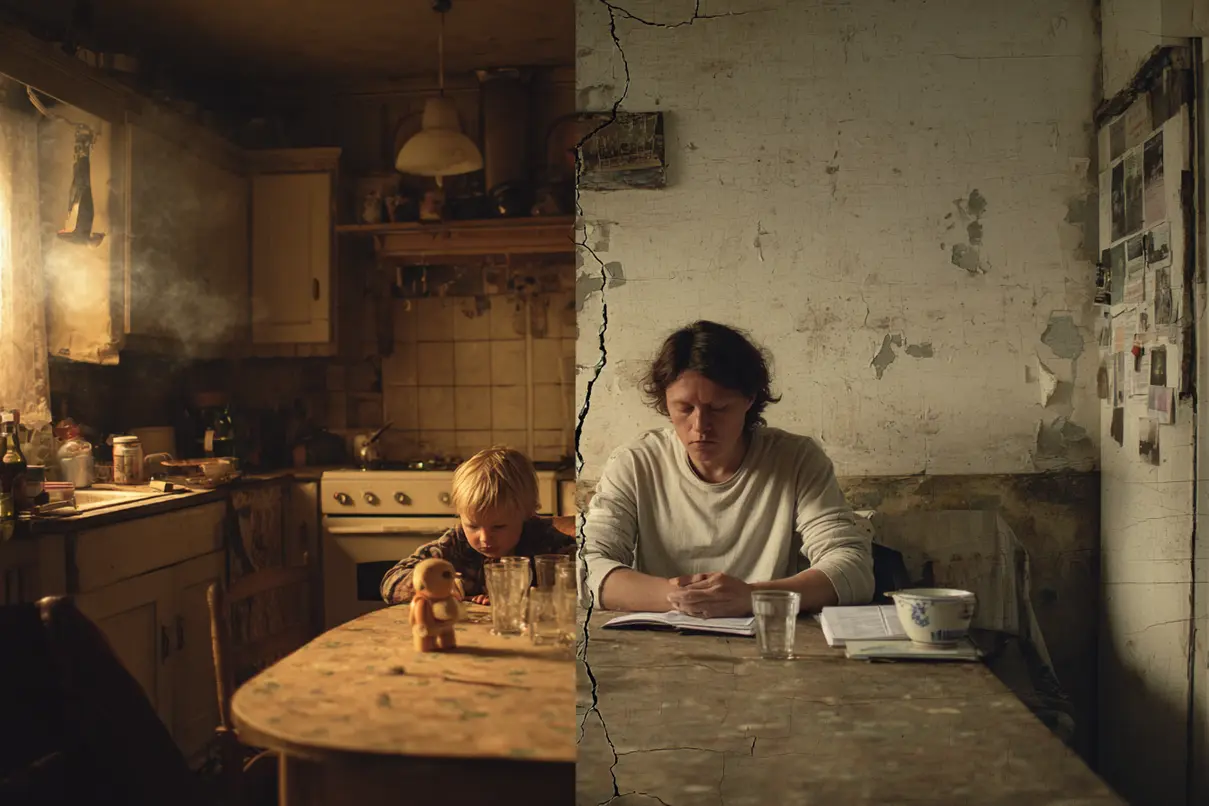
A person can be grown, working, building relationships, raising children, and still listening for footsteps somewhere inside. They may know from the sound of a key what state a parent is in. From a voice, whether there will be a fight. From silence, not peace but tension: it is too quiet, something is coming.
In an OpenHalt conversation, Masha Nikolaeva and psychologist Yulia Eshchenko talk about adult children of alcoholics, often called ACOA. Not as a label and not as a life sentence. As a way to understand why growing up in a family with addiction can remain in intimacy, self-worth, goals, shame, and the constant expectation that something will go wrong.
What ACOA Means
Adult children of alcoholics are adults who grew up in a family where one or both parents had an addiction. Historically, the term focused on alcoholism, but today the conversation often includes other substance and behavioral addictions as well.
Yulia immediately widens the frame: a person with addiction does not live outside the family system. Their behavior affects everyone close to them: partners, children, parents, and the people who live around the addiction.
This is where conversations about codependency, adult children, and family dysfunction begin. ACOA and codependency often overlap, but they are not identical. ACOA is about the childhood experience of growing up around an addicted parent or in another dysfunctional family system.
A Functional Family Is Not a Perfect Family
Yulia makes an important distinction: a functional family is not a family where everything is always fine. That does not exist. Children even need some frustration in order to grow.
A functional family is one that does its basic job: safety, care, nourishment, predictability, and the hope that an adult will be available.
Psychologically, it is a family where a child knows: if I call for my mother or father, someone will hear me. Not perfectly. Not without mistakes. But reliably enough.
In a dysfunctional family, essential parts of that structure fall out. In a family with addiction, predictability and safety are often the first to go.
“I Could Tell by the Sound of the Key”
One of the strongest images in the conversation is an adult remembering: “I could tell by the sound of the key turning that my father came home drunk.” Or by the footsteps, that a fight was coming.
A child learns to notice tiny signals. The key. The voice. The way a bag is put down. The look in someone’s eyes.
From the outside, this can look like empathy. The person is sensitive, reads people quickly, adjusts to the room. But sometimes that empathy has a cost. It is not only kindness. It is a survival skill: if I notice danger early enough, I can prepare.
What ACOA Carry Into Adult Life
Yulia is careful: there is no formula that says, “If your parent drank, you will become this exact kind of person.” Adult children of alcoholics are a very diverse group. But some themes appear often.
The first is difficulty with close relationships. A person waits for the catch. Things cannot be this good. If a partner is stable, it may not feel calming. It may feel suspicious: when will this end?
The second is anxiety and trouble focusing. It may be hard to get going in the morning, while at night, when everyone is asleep and the threat feels lower, energy appears.
The third is difficulty with goals. A person starts, stops, blames themselves for laziness or weakness. But behind that may be not laziness, but a nervous system shaped in chaos, where long stable movement was hard to learn.
The fourth is self-worth. Not just “I cannot do this,” but “something is wrong with me.”
Laughing While Telling Terrible Stories
The conversation names another familiar detail: a person tells a traumatic story and laughs.
“Dad came home and was lying under the window,” and the person laughs. Everyone else listens in horror.
Yulia describes this as a protective response. The laughter does not necessarily mean joy. Sometimes it is a way not to fall into the pain.
Adult children of alcoholics can also look extremely strong. They endure, organize, work, carry everyone. Other people see them as unbreakable. Inside, it may be less freedom and more the old habit of not showing fear, even to themselves.
“I Will Never Be Like Them”
Many ACOA make a promise: I will not be like my mother. I will not be like my father.
At first, this sounds like freedom. But Yulia points out that if identity is built entirely around “I am like them” or “I am the opposite of them,” the parent is still the central point of comparison.
Some people repeat the family script. Others run in the opposite direction: if the parent drank, I will never go near alcohol; I will train seven days a week; I will control everything.
The opposite script may look healthy, but inside it may be held together by intense tension. The person is still orbiting the family story.
Intergenerational Trauma Without Mysticism
Yulia separates psychology from mysticism. This is not about curses or magical family fields. It is about inherited ways of living.
If a grandfather drank and was dangerous, his child grows up traumatized. Even if that child never becomes addicted, they may become anxious, controlling, cold, or emotionally unavailable.
Then they pass on not a curse, but habits: stay silent, do not stand out, hide success, fear money, control everything, do not feel.
It is similar to passing down a family habit of drinking tea with meals. Only what gets passed down is not just a routine, but a survival strategy.
Do You Have to Forgive Your Parents?
Many people fear that therapy will force them to forgive their parents.
Yulia answers clearly: forgiveness is not required. Some things may not be forgivable. The level of forgiveness is not the level of psychological health.
In therapy, a person may discover that they want to forgive, can forgive, do not want to forgive, or are not ready to approach that topic. All of those are possible.
The goal is not to check a box that says “I forgave.” The goal is to stop living only around pain, comparison, shame, or an inner trial that never ends.
When Therapy Helps and When It May Not Be Needed
Growing up in a dysfunctional family does not mean a person must urgently dig through the past.
Some people had protective factors: a resilient psyche, another safe adult, friends, teachers, a different environment. They may live their lives and not feel the need to work through this right now.
The principle is simple: do not treat what does not hurt.
But if it hurts, it is worth looking closer. Not to find someone to blame, but to see whether today’s pain has roots in childhood.
Questions to Ask Yourself
Do I feel satisfied in my closest relationships? How do I feel in friendship, family, partnership? Do I feel at home in my own life? Are there areas where I cannot focus again and again? What do I tell myself when I do not reach a goal? Can I rest without anxiety? Am I always waiting for something bad to happen?
If the answers hurt, it may be worth exploring. Especially if there was addiction, violence, chronic unpredictability, shame, or secrets in the family.
A Psychologist’s Perspective
The ACOA topic matters not because it gives a person another label. Most people already have enough labels.
It matters because it can replace “something is wrong with me” with a more precise question: what conditions shaped me, and what did I have to learn in order to survive?
Anxiety, control, fear of intimacy, being active at night, laughing at painful stories, and feeling “I must handle everything” may once have been adaptations. What helped a child survive can keep an adult from living freely.
Therapy for ACOA is not a trial of the parents. It is a slow restoration of connection with the self, feelings, boundaries, choice, and adult life.
What You Can Do
- Do not diagnose yourself from a list of traits alone.
- Look at your relationships: is there closeness, trust, or constant expectation of a catch?
- Notice control: where does it help, and where does it keep you tense?
- Pay attention to “I will never be like my mother/father” and ask whether it comes from freedom or fear.
- If there was addiction, violence, or chaos in your family, tell your therapist.
- Do not force yourself to forgive.
- Look for support: therapy, ACOA groups, safe relationships, and people around whom you do not have to read every footstep.
FAQ
Who are adult children of alcoholics?
They are adults who grew up in a family where one or both parents had an addiction. That experience can affect relationships, anxiety, self-worth, control, and the sense of safety in adult life.
Is ACOA a diagnosis?
No. It is not a medical diagnosis. It is a concept that helps describe the impact of growing up in an alcoholic or otherwise dysfunctional family.
What traits are common in ACOA?
Common themes include expecting something to go wrong, anxiety, control, difficulty with intimacy, fear of becoming like the parents, trouble with goals, shame, guilt, and the habit of being strong.
Do I have to forgive my parents?
No. Forgiveness is not a required stage of healing. In therapy, a person can decide what they want and are able to do with that part of their story.
Takeaway
ACOA is not a sentence, and it does not explain a whole life with one abbreviation. It is a way to see that some things a person calls “my character” may have been survival strategies in an unpredictable home.
An adult does not have to live only by those old signals. They can learn not to expect danger in calm, not to build themselves only in opposition, not to laugh when they want to cry, and not to carry the world just to prove they can.
Keep reading
- Codependency: when love got sick
- How to leave codependency: first steps
- Alcohol addiction defense mechanisms
OpenHalt
OpenHalt talks about addiction and its impact on the whole family. Not only on the person who uses, but also on those who grew up nearby, read moods from footsteps, stayed silent, rescued, felt ashamed, and learned to be strong.
If you recognize yourself in the ACOA theme, it does not mean something is wrong with you. You may have spent too long in conditions where you had to survive. One safe conversation can be a first step back to your own life.