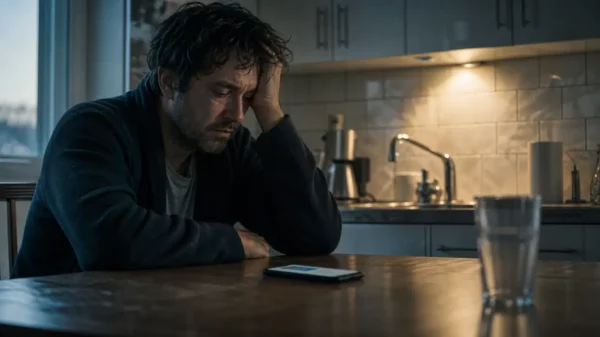


When someone is already scared but still hiding
Drug dependence rarely begins with the word dependence. It may begin with curiosity, a group of people, pain, anxiety, insomnia, loneliness, work pressure, or the wish to stop feeling for a while.
Then another life starts forming: contacts, routes, money, secret chats, excuses, promises, fear, disappearance, recovery days, and stories told to loved ones. A person can look functional during the day and panic at night because they know substance use is no longer an occasional episode. It has become a system.
The loneliest thought is not always “I want to use.” Sometimes it is: “If I tell the truth, shame will destroy me.” So the person hides, negotiates, tries to control the dose, the people, the timing, the consequences. Meanwhile the dependence takes up more room.
This article is educational and does not replace care from a doctor, therapist, or psychiatrist. If there is overdose risk, severe withdrawal, loss of consciousness, seizures, psychosis, mixed substances, suicidal thoughts, self-harm, violence, or dangerous behavior, seek urgent local medical or crisis help.
Signs that should not be explained away as “just a phase”
Drug dependence can look different depending on the substance: opioids, stimulants, cannabis, sedatives, prescription medications, or several substances at once. But in daily life, similar patterns often show up.
Substance use starts planning the day
The person thinks about where to get it, when to use, how to hide it, how to recover, how to explain being absent, how to get through the next day. Even when the substance is not present, the day is already organized around it.
Control becomes a promise, not a fact
“Only today.” “Less than before.” “I know my limit.” “I can stop.” “It’s not that kind of drug.” When control has to be defended in words again and again, it is time to look at behavior.
People and routes change
There are contacts, places, trips, chats, and routines that cannot be spoken about calmly. Old relationships shrink, not because they stopped mattering, but because honesty around them became harder.
The body starts sending signals
Sleep, appetite, weight, skin, anxiety, irritability, pain, panic, memory gaps, exhaustion, sexual risk, infections, injuries, and signs of dangerous situations may appear. Not every sign is visible, but the person often knows the body is paying.
Why fear of the truth makes dependence stronger
Shame pushes people into hiding. Dependence works well in locked rooms. The fewer people know the truth, the easier it is for the illness to set rules: one more time, do not tell anyone, handle it alone, stop later.
Stigma around drugs is especially harsh. People fear being reduced to a label, losing their voice, or hearing only blame. But shame-based language rarely helps someone get out. More often, it keeps the person where help feels impossible.
Anti-stigma language does not excuse harm or erase responsibility. It creates a condition where someone may tell the truth before overdose, arrest, family rupture, or serious health damage.
Overdose and withdrawal: when you should not be alone
There are parts of drug dependence where private promises are not enough. Overdose, mixed substances, loss of consciousness, slowed or abnormal breathing, seizures, psychosis, severe paranoia, severe pain, dangerous withdrawal, or suicidal thoughts require urgent help.
For opioid use disorder, medication treatment can be lifesaving and evidence-informed. Methadone, buprenorphine, naltrexone, and other approaches may be used when clinically appropriate and supervised. DIY plans, abrupt stopping, random pills, and advice from group chats can be dangerous.
With stimulants, the risks may include insomnia, anxiety, exhaustion, panic, irritability, paranoia, and risky decisions. With sedatives and mixed use, risks can include respiratory depression, falls, blackouts, and dangerous withdrawal. The more substances are involved, the less safe it is to rely on “I’ll figure it out alone.”
Treatment is not only detox
Detox can be necessary, but it is not the whole treatment. After detox, triggers remain: people, routes, stress, emptiness, depression, debt, shame, old habits, and a body that is still recovering.
NIDA, SAMHSA, ASAM, WHO/UNODC, and NICE materials describe care as multi-component: medical assessment, treatment of co-occurring conditions, psychosocial support, family work, continuing care, overdose prevention, and relapse prevention.
For one person, the first step may be a doctor. For another, a support group where they can tell the truth without performing. For another, therapy for shame and trauma. For another, a safety plan for the next 24 hours because today the question is not philosophy; it is how not to use and not to be alone.
What loved ones can do
Loved ones may want to scream, rescue, check messages, threaten, forgive everything, or control every move. That fear is real. But chaotic control often makes the home even more explosive.
It is safer to stay with facts and boundaries: what you see, what you will no longer hide or pay for, what help you can support, and what you will do if there is danger. If there is risk of overdose, violence, psychosis, or suicide, the priority is urgent safety, not a moral argument.
Loved ones need support too. Drug dependence can pull the whole family into the vortex: sleep, money, trust, health, and the ability to think about anything else.
What you can do in the next 24 hours
Name the risk plainly
Write down what substances are involved, how often, how much, with whom, where, what is mixed, and whether there has been overdose, loss of consciousness, psychosis, seizures, dangerous behavior, or suicidal thoughts.
Remove one fast access point
Delete a contact, block a chat, change a route, remove substances and using objects from home, avoid people with whom using is almost guaranteed. Not everything at once. One entrance into the cycle today.
Find a medical entry point
If opioids, sedatives, mixed substances, severe withdrawal, pregnancy, psychosis, past overdose, or suicide risk are involved, the first step should include medical assessment.
Send one honest message
“I’m using, and I’m scared I can’t stop alone.” Send it to a clinician, a group, a trusted person, or an anonymous chat. Dependence loses power not through perfect wording, but through leaving secrecy.
A psychologist’s view
Psychologically, drug dependence often survives on the promise of a fast exit from the self. Do not feel shame. Do not feel the body. Do not think. Do not remember. Do not be alone. Sometimes the substance is no longer pleasure; it is an off switch.
So the first useful question is not “why did you do this?” A better question is: “What felt impossible to survive without it?” The answer does not excuse using, but it shows where help is needed: trauma, anxiety, depression, fear of closeness, insomnia, pain, emptiness, or not knowing how to ask.
FAQ
How do I know substance use has become dependence?
If the substance repeatedly overrules decisions, takes more time, money, or secrecy, harms health, relationships, work, or safety, and attempts to stop do not hold, professional assessment is needed.
Can someone quit drugs on their own?
Some people stop without formal treatment, but opioids, sedatives, mixed substances, severe withdrawal, pregnancy, psychosis, overdose history, or suicide risk require medical help.
What should I do if I suspect an overdose?
Do not wait for it to pass. Call emergency services in your country. Abnormal breathing, loss of consciousness, seizures, blue lips, extreme sleepiness, or unusual behavior can become life-threatening within minutes.
How do I talk to a loved one who is using?
Use concrete facts and safety language, not labels. Avoid empty threats. Offer help, state boundaries, and act urgently if there is risk to life or violence.
OpenHalt
OpenHalt talks about drug dependence without shame and without romanticizing it. If substance use has become a secret system, a person does not need another inner trial. They need safe contact and a next step.
You can begin with one honest sentence: “I’m using, and I’m afraid of where this is going.” You do not need to prove that things are bad enough.
If there is overdose risk, psychosis, suicidal thoughts, violence, or dangerous withdrawal, contact local emergency medical or crisis support first.
Join the chat “Using and afraid to say it”
Keep reading
- Addiction recovery safety plan: how to reduce relapse risk
- How addiction changes the brain and body
- Addiction recovery: relapse, motivation, and family support
Sources
- NIDA. Principles of Drug Addiction Treatment: A Research-Based Guide – 2018; supports comprehensive and continuing treatment principles.
- SAMHSA TIP 63. Medications for Opioid Use Disorder – 2021; supports medication treatment framing for opioid use disorder.
- ASAM. National Practice Guideline for the Treatment of Opioid Use Disorder – 2020 update; supports OUD clinical care and overdose-prevention framing.
- WHO / UNODC. International Standards for the Treatment of Drug Use Disorders – 2020; supports ethical, continuous, evidence-informed care.
- NICE CG51. Drug misuse in over 16s: psychosocial interventions – 2007; supports psychosocial interventions and family work.
- Livingston et al. The effectiveness of interventions for reducing stigma related to substance use disorders – Addiction, 2012; DOI: 10.1111/j.1360-0443.2011.03601.x; PMID: 21815959; supports anti-stigma language.
- Stellern et al. Emotion regulation in substance use disorders – Addiction, 2023; DOI: 10.1111/add.16001; PMID: 35851975; supports the link between SUD and emotion regulation.
- Chan et al. Pharmacotherapy for Cocaine Use Disorder – Journal of General Internal Medicine, 2019; DOI: 10.1007/s11606-019-05074-8; PMID: 31183685; supports caution when discussing stimulant/cocaine medication claims.