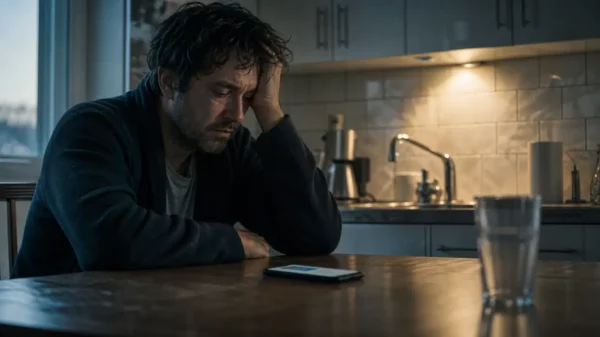


The moment addiction stops sounding like someone else’s word
Most people do not begin with “I have an addiction.” They begin with smaller sentences: “I’m just stressed,” “I can stop when I need to,” “It’s not that bad,” “Other people are worse.” Families often repeat those lines too, because naming the problem can feel like opening a door nobody is ready to walk through.
Addiction usually becomes visible through repetition. A promise to stop. A return to use or behavior. Shame. Secrecy. A new explanation. Another promise. Meanwhile life gets smaller: less sleep, less honesty, less money, less trust, less contact with the person’s own needs.
This article does not diagnose anyone. Diagnosis belongs with a qualified clinician. It gives a careful way to notice when a habit, substance, or behavior may be turning into something that is taking more control than the person wants to admit.
Addiction is not the same as having a weak character
In everyday language, addiction is often explained through blame: “They chose it,” “They don’t care,” “They just need discipline.” That may feel simple. It is not very useful.
The American Psychiatric Association describes substance use disorder as a condition where a person continues using a substance despite harmful consequences and day-to-day functioning becomes impaired. APA groups symptoms into areas such as impaired control, social problems, risky use, tolerance, and withdrawal.
That does not remove responsibility. A person still needs choices, treatment, boundaries, support, and sometimes medical care. But responsibility is not the same as humiliation. When the only message is “pull yourself together,” people often get more shame and less access to help.
How addiction shows up before it has a name
Addiction does not look the same in every life. For one person it is drinking after work until every evening belongs to alcohol. For another, it is gambling that first felt like a private thrill. For someone else, it may be medication that began as treatment and slowly became the only way to get through fear, sleep, or pain.
The common thread is not the substance or behavior. The common thread is a shrinking sense of freedom.
- The person plans to stop or cut back, then returns to the same pattern.
- Consequences are explained away as stress, a bad week, or “just this once.”
- Family members start monitoring, rescuing, arguing, or staying silent.
- Shame, secrecy, debt, lying, or loss of interest in everyday life grows.
- Health, work, relationships, safety, or legal stability begin to suffer.
At that point, the question “Is this addiction?” can become a trap. A better question is: what is already being damaged, what keeps repeating, and what kind of support is needed before the harm gets worse?
Why willpower is not enough
Research does not point to one single cause. Addiction risk can involve the brain, learning, stress, social environment, access to substances or behaviors, trauma history, mental health, family patterns, and stigma. Systematic reviews and meta-analyses used for this article connect addiction-related risk with emotion regulation, co-occurring mental health conditions, adolescence, chronic pain, social vulnerability, and stigma.
This does not mean a person is doomed. Biology can raise risk, but it does not close the door to recovery. Support, treatment, safer environments, honest assessment, emotion regulation, medication when indicated, and harm reduction can change the path.
The dangerous shortcut is trying to find one clean explanation: genes, childhood, friends, personality, stress. In real life, addiction usually forms through several lines at once. That is why help often needs more than one tool: not only a rule, not only a conversation, not only rehab, not only a group, not only medication. The plan has to fit the person.
Warning signs worth taking seriously
Not every risky episode means addiction. Not every concern requires intensive treatment. But some signs deserve action rather than another month of bargaining.
Loss of control
The person planned one thing and did another: less, later, only today, last time. Then it happened again. If control mostly exists in promises, it is a signal.
Visible harm
Sleep, health, work, school, money, parenting, relationships, or safety are affected, and the substance or behavior continues.
Life starts organizing itself around the cycle
There is waiting, planning, hiding, recovering, finding money, making excuses, or fearing exposure. More energy goes into maintaining the cycle than into living.
Shame makes the problem lonelier
Stigma can make people hide. Someone may sound defensive or angry on the outside while privately feeling terrified: “If I admit this, what happens to me?”
What a loved one can do without becoming the police
Family members often see the danger before the person is ready to name it. The impulse is understandable: shake them, persuade them, prove the point, rescue them. But rescue can turn into control, and control can burn everyone out.
Start with facts rather than a label:
- “I see this pattern repeating.”
- “I’m scared about your safety.”
- “I won’t hide or pay for the consequences.”
- “I can help you look for a clinician, group, or support option.”
- “If there is danger to life, I will contact urgent help.”
A boundary is not revenge. It is a way to stop the wider addiction system from growing: secrecy, debt, threats, emotional chaos, and the slow disappearance of everyone’s real needs.
A psychologist’s view
In therapy, addiction is often explored as a cycle: tension, action, short relief, consequences, shame, and new tension. If the work focuses only on stopping the action, the person may hold on for a while without understanding what keeps pushing them back into the same loop.
A clinician will usually look wider: emotions the person cannot manage, where support disappears, what is happening with sleep, money, relationships, physical health, and access to the substance or behavior. Depression, anxiety, trauma, suicide risk, psychosis, severe withdrawal, and overdose risk need separate assessment.
If there is overdose, loss of consciousness, severe withdrawal, psychosis, risk of violence, self-harm, or suicidal thoughts, do not treat this as a blog-reading moment. Contact local emergency services or the nearest medical/crisis service.
The first step does not have to be dramatic
Many people avoid help because they imagine the first step has to be huge: confess to everyone, enter treatment immediately, change their whole life, never slip again. That picture can make help feel impossible.
A first step can be smaller:
- tell one safe person what has been happening;
- write down what keeps repeating and what has already been damaged;
- reduce the closest risk: access, money, substances, betting apps, unsafe contacts;
- speak with a clinician without promising to solve everything at once;
- try a support group or anonymous chat;
- make a plan for the next 24 hours.
For some people, medical assessment matters immediately, especially when withdrawal, mixed substances, pregnancy, chronic pain, psychiatric symptoms, suicidal thoughts, or overdose history are present.
FAQ
Is addiction a disease or a choice?
It is not honest to reduce addiction to only one of those words. Clinically, addiction involves biological, psychological, and social factors. A person is not to blame for vulnerability, but they do need responsibility, support, and safety-focused steps.
How do I know it is time to get professional help?
If loss of control keeps repeating, harm is visible, secrecy grows, money or relationships are affected, or safety is at risk, do not wait for “rock bottom.” A professional can help assess risk and choose the next step.
Can someone recover on their own?
Some people reduce risk early, but addiction often requires outside support: medical care, therapy, peer support, medication when indicated, and family support. Doing it “on your own” should not mean doing it alone.
What if the person denies the problem?
Talk about concrete facts and consequences instead of arguing forever about the label. Set boundaries, stop covering harm, and get support for yourself. If there is risk of violence, overdose, or suicide, use urgent help.
OpenHalt
OpenHalt is for people who need a first step that does not begin with a speech, a confession, or a perfect plan. If you recognize yourself or someone close to you in this article, you can start with one anonymous conversation and figure out what feels safe next.
If there is overdose risk, suicidal thoughts, severe withdrawal, psychosis, or danger to life, seek urgent help in your country.
Join the chat “What addiction is”
Keep reading
- How addiction changes the brain and body
- Addiction recovery safety plan
- Self-esteem and self-worth in addiction recovery
Sources
- American Psychiatric Association: What Is a Substance Use Disorder? – current APA clinical information; supports the definition of SUD, symptom groups, and treatment framing.
- National Institute on Drug Abuse: Principles of Drug Addiction Treatment, Third Edition – NIDA, 2018; supports the need for comprehensive, individualized, continuing treatment.
- UNODC / WHO: International Standards for the Treatment of Drug Use Disorders – WHO/UNODC, 2020; supports ethical and evidence-based treatment systems.
- World Health Organization: mhGAP guideline for mental, neurological and substance use disorders – WHO, 2023; supports routing for substance use, depression, and suicide risk in accessible care settings.
- Livingston et al. The effectiveness of interventions for reducing stigma related to substance use disorders – Addiction, 2012; DOI: 10.1111/j.1360-0443.2011.03601.x; PMID: 21815959; supports anti-stigma framing.
- Ray et al. Combined Pharmacotherapy and Cognitive Behavioral Therapy for Adults With Alcohol or Substance Use Disorders – JAMA Network Open, 2020; DOI: 10.1001/jamanetworkopen.2020.8279; PMID: 32558914; supports combining medication and behavioral care when indicated.
- Stellern et al. Emotion regulation in substance use disorders – Addiction, 2023; DOI: 10.1111/add.16001; PMID: 35851975; supports the connection between addiction and emotion regulation.